Overview
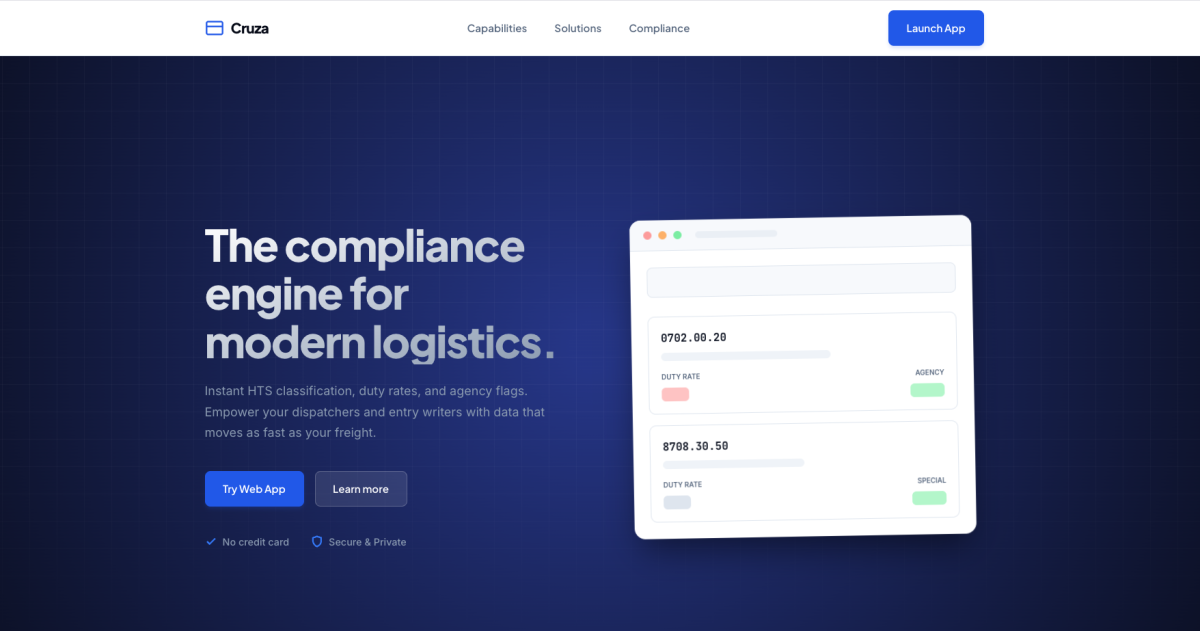
Cruza is a Progressive Web App that provides instant HTS code lookup, duty estimation, and compliance requirements for cross-border logistics. We built it end-to-end in three weeks as both a product experiment and a functional tool for real-world use. The app is designed to work offline, support bilingual search, and operate without traditional user accounts by using a device-bound license model instead. Today, it is actively used by several logistics businesses and has demonstrated clear value in reducing pre-broker research time.
Context
In US–Mexico trade operations, determining tariff classifications, duties, and required filings is a routine but time-consuming task. This work is often done under time pressure and with incomplete information. Existing workflows typically involve searching HTS codes across reference systems, interpreting duty structures manually, checking agency requirements separately, and translating between English and Spanish terminology. We created Cruza to consolidate these steps into a single, fast tool designed for operational environments such as dispatch desks, warehouses, and field use.
The Problem
The core problem was not a lack of information, but rather friction in accessing and using it quickly. We identified several key issues:
-
Users often do not know exact HTS codes.
-
Terminology varies between English and Spanish.
-
Duty structures are complex and inconsistent.
-
Information is spread across multiple sources.
-
Internet access is unreliable in some working environments.
This results in wasted time, repeated manual work, and unnecessary reliance on brokers for early-stage validation.
Goals and Constraints
Goals
-
Enable fast, flexible HTS lookup via code or natural language.
-
Provide immediate duty estimates with minimal input.
-
Surface compliance requirements alongside classification.
-
Support bilingual workflows in English and Spanish.
-
Work reliably offline.
-
Explore a non-standard distribution model that is license-based with no accounts.
Constraints
-
Highly inconsistent duty formats including percentages, currency per kilogram, and compound rates.
-
Static dataset requiring manual preparation.
-
The need for very fast performance on mobile devices.
-
Minimal backend consisting only of license validation.
Our Role
We built Cruza independently and owned all aspects of the project:
-
Product ideation and positioning.
-
UX and interface design.
-
Frontend and application architecture.
-
Search logic and data modeling.
-
Duty calculation logic.
-
Licensing system design.
-
Distribution and monetization via Gumroad.
-
Marketing and initial user acquisition.
Approach
The project focused on making complex regulatory data usable in seconds instead of minutes.
1. Search That Handles Uncertainty
We designed a search system that works even when the user does not know the exact input. This includes code-based prefix matching for known HTS codes, tokenized text search for product descriptions, and bilingual term expansion. We also utilized fuzzy matching to surface likely results. This reduces dependency on exact terminology.
2. Structuring Messy Data
A significant portion of the work involved preparing and structuring the HTS dataset. We normalized tariff entries into a consistent schema, encoded duty formats as parsable strings, and mapped agencies to required forms. We ensured data could be efficiently queried client-side. While this was largely manual and time-intensive, it was critical to making the app usable.
3. Client-Side Duty Computation
We implemented a parser to handle real-world duty formats:
-
Ad valorem (e.g., 6.8%).
-
Specific (e.g., $1.035/kg).
-
Compound (e.g., $1.034/kg + 17%).
-
Special or free cases.
Users can input value or quantity directly and receive an estimated duty and landed cost instantly.
4. Offline-First Architecture
Given the working environment, offline capability was essential. We utilized a service worker with a cache-first strategy and a pre-cached HTS dataset. This ensures full functionality without network access in warehouses or cross-border settings.
5. Alternative Monetization Model
Instead of building a traditional SaaS product, we experimented with a simpler model. There are no user accounts. Instead, a lifetime license is sold via Gumroad and tied to a single device. Local validation occurs after activation, which reduces product complexity while still enabling monetization.
Solution
Cruza delivers a focused, single-purpose tool with the following capabilities:
-
HTS Code Search (code or natural language).
-
Bilingual Search (English and Spanish).
-
Duty Calculator (instant estimation).
-
Compliance Visibility (agency and forms).
-
Offline Usage (via PWA).
-
Installable App Experience.
-
Device-Based Licensing.
Key Decisions and Tradeoffs
-
Offline-First vs. Data Freshness: We prioritized speed and reliability over real-time updates. This requires an acceptance that data may require manual updates.
-
No Accounts vs. Traditional SaaS: We eliminated authentication complexity. The tradeoff is limited flexibility in user management.
-
Client-Side Logic vs. Backend Processing: This reduced infrastructure needs but increased frontend complexity.
-
Simplicity vs. Feature Depth: We focused on a narrow, high-frequency use case and avoided expanding into full customs workflow tooling.
Outcome
-
Rapid Deployment: Built and launched in 3 weeks.
-
Market Adoption: Currently used by 5 logistics businesses.
-
User Impact: Feedback confirms the tool drastically compresses research timelines. One user noted that while they previously waited days for official tariff consultations, they can now provide accurate preliminary classifications to their clients within minutes.
-
Efficiency: The tool successfully surfaces dozens of relevant classifications in approximately one second, reducing the need for early broker involvement and saving operational costs.
What We Learned
-
Strategic Simplicity in Distribution: By choosing a license-based model over a traditional SaaS account system, we intentionally bypassed the complexity of authentication, onboarding flows, and heavy backend management. This allowed us to focus our three-week timeline entirely on the core search and calculation logic.
-
Data Preparation Is Often the Hardest Part: Structuring HTS data and duty formats required more effort than the UI or logic.
-
Narrow Tools Can Be Valuable: A focused, single-use tool is useful if it solves a real friction point well.
-
Speed to Build Matters: Shipping a working product in three weeks enabled real-world validation quickly.