Overview
Mixyt is a collaborative platform built on a simple human-centric premise. Music discovery should be intentional and social instead of a byproduct of an opaque algorithm. Instead of passive infinite feeds, Mixyt treats playlists as creative artifacts that are authored, attributed, and shaped by deliberate constraints.
What started as an MP3 prototype evolved into a YouTube-powered system. This shift allowed us to move the technical friction away from hosting and streaming to refocus our energy on what actually matters: curation and clarity.
The Philosophy: Pragmatic Engineering
At Tech-Mex, we advocate for the Web Platform and staying close to the metal. However, we are engineers first. We chose Next.js (App Router) and React for Mixyt as a strategic professional proof of concept.
While frameworks can be syntactic sugar, being a versatile UI architect means proving you can step into any stack. Whether it is a legacy React mess or a modern Next.js app, we can deliver a robust solution. Mixyt is our way of showing that we know the fundamentals but can play the industry game too.
The Challenge: Meaning vs. Friction
Modern streaming platforms have optimized for engagement at the cost of authorship:
-
Playlists lack intent because they are often generated or forgotten rather than built.
-
Collaboration is an afterthought since shared lists rarely feel like true co-creations.
-
Context is missing because you see a recommendation but never the reason or the person behind it.
Our Approach: Systems Over Features
1. The Metadata Safety Net
By moving to a YouTube-based model, we removed the burden of storage. Critically, we introduced an optional metadata fallback. By encouraging curators to add artist and track names, we ensured that the human intent remains searchable even if a specific YouTube URL is geoblocked or deleted.
2. Constraints as a Feature
We treated limitations as a design tool to prevent lazy curation:
-
Cap of 60 videos forces selectivity.
-
Rich metadata requirements for titles and descriptions give each list a distinct identity.
-
Attribution-first design makes every contributor visible to turn the playlist into a shared document.
3. Engineering for Editorial Clarity
The interface intentionally avoids typical streaming patterns by opting for:
-
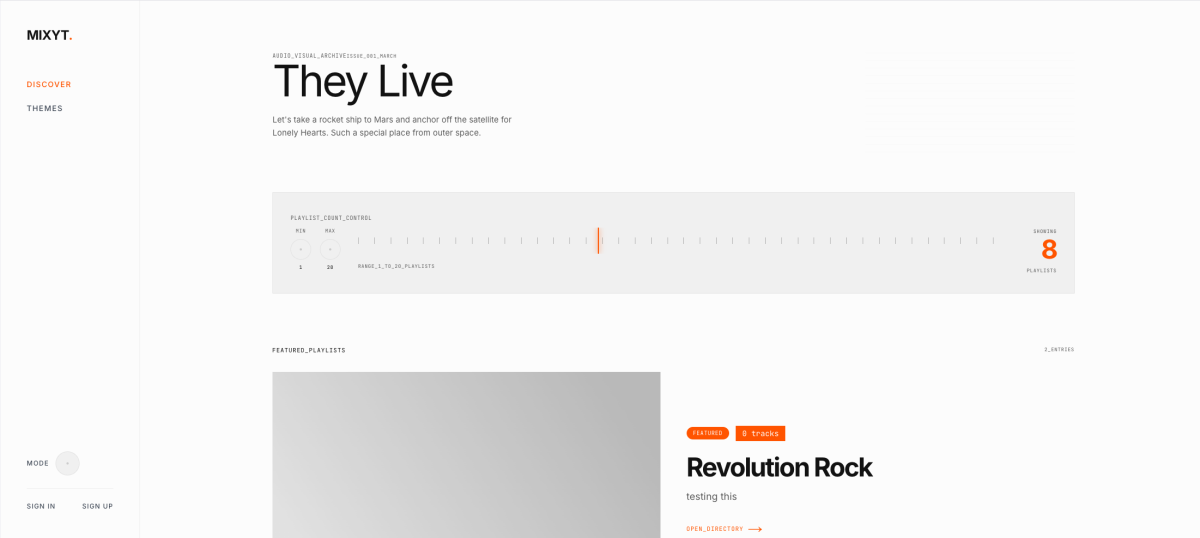
Minimalist layout and strong typography.
-
A grayscale-to-color interaction model.
-
A challenge system with structured community prompts to turn playlists into active responses.
Critical Reflection: Lessons in Complexity
While the product achieves its goal of non-algorithmic discovery, the Playlist Creation UX remains a point of friction. In our pursuit of intentionality, we overloaded the creation flow with too many inputs.
If I were to apply my vanilla philosophy to a redesign today, the first thing to go would be Tailwind CSS. While useful for speed, the utility-class noise often obscures the semantic clarity needed for complex state-heavy forms. Stripping it back to Vanilla CSS would allow for more nuanced editorial interactions that feel less like a template and more like a crafted experience.
Outcome
Mixyt stands as a fully functional full-stack testament to what happens when you prioritize people over patterns. We have proven that we can navigate modern frameworks like Next.js while maintaining a deep respect for the architectural decisions that keep a system maintainable and human.