Overview
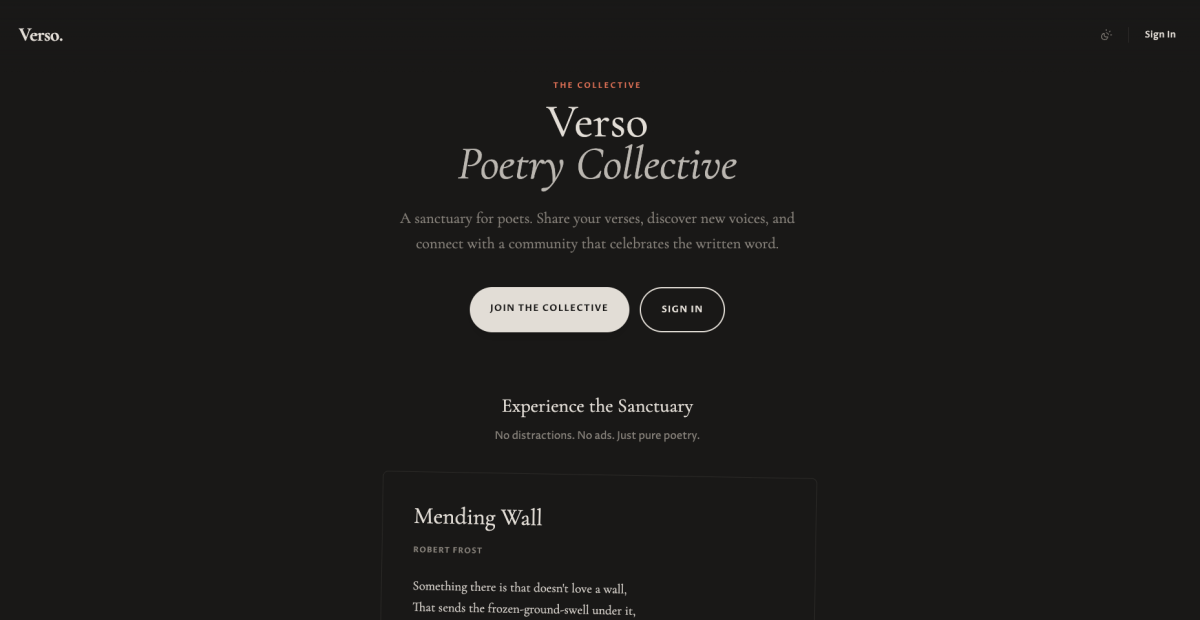
Verso is a focused, web-based platform designed for a "poetry collective" experience. It prioritizes a distraction-free writing environment and a lightweight social layer for discovery. The project demonstrates a balance between creative expression and structured architectural design, with a heavy emphasis on typography, perceptual color consistency, and developer ergonomics.
The Challenge: Balancing Power and Pragmatism
While many writing platforms prioritize broad social engagement, they often clutter the creative process. Verso was built to solve the tension between private drafting and public sharing within a minimal, aesthetic environment.
A significant architectural challenge arose during development regarding infrastructure. Initially, the project explored PocketBase as an all-in-one backend solution. However, the server and hosting requirements proved to be a distraction from the core product goals. To avoid a significant pivot into unfamiliar DevOps territory, the decision was made to move toward a more familiar, scalable "serverless" stack using Turso and Drizzle ORM.
The Approach
1. A Modular, Authenticated Architecture
The application is built on SvelteKit 2 using Svelte 5's runes for reactivity. To enforce clear boundaries between marketing, authentication, and the core app experience, the system uses SvelteKit route groups:
-
(marketing): Public-facing landing pages.
-
(auth): Dedicated flows for login and signup handled by Lucia.
-
(app): The gated, authenticated "collective" experience.
2. Data Integrity and Privacy
With the move to Turso (libSQL) and Drizzle ORM, privacy enforcement moved from configuration to implementation.
-
Access Control: User sessions are loaded per request into server
localsvia Lucia. -
Visibility Rules: The system manages a complete CRUD lifecycle for poems, allowing authors to toggle between "public" and "private" states, ensuring personal drafts remain shielded from the discovery feed.
3. Perceptual Theming System
As a UI-first project, Verso utilizes a centralized design token system within a Tailwind CSS 4 environment.
-
OKLCH Color Space: Themes are defined using the OKLCH color space to ensure perceptual consistency across light and dark modes.
-
Typography: The UI is optimized for legibility, treating the poem as the primary interface element.
Key Architectural Decisions
-
The "Black Box" vs. "Legos" Tradeoff: Moving away from PocketBase allowed for greater control over the data layer and reduced hosting complexity, aligning the stack with a "stay close to the metal" philosophy.
-
Authenticated-Only Access: To maintain community integrity, all poetry content is gated behind a login, prioritizing a secure collective over open-web anonymity.
-
Component-Driven UI: Reusable components like
PoemCardandPoemFormallow for a consistent aesthetic while keeping the codebase maintainable.
Outcome & Learnings
Verso successfully delivers a cohesive writing platform that balances a minimal feature set with a robust, modern architecture. The project highlights that:
-
Pragmatism wins: Recognizing when a technology (like self-hosting PocketBase) is a distraction allows for faster shipping and a better-focused product.
-
Architecture shapes the experience: Gating content and focusing on typography creates a specific "vibe" that distinguishes the platform from generic social media.
-
Foundations matter: Using modern tools like Svelte 5 and Tailwind 4 provides a scalable foundation for future enhancements, such as deeper social interactions or advanced editor features.